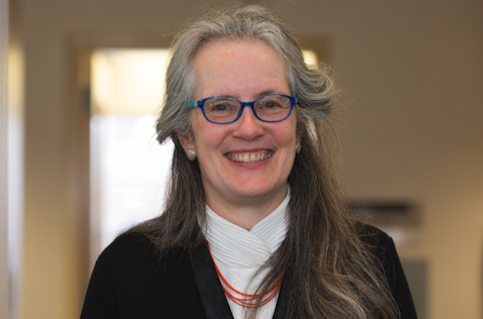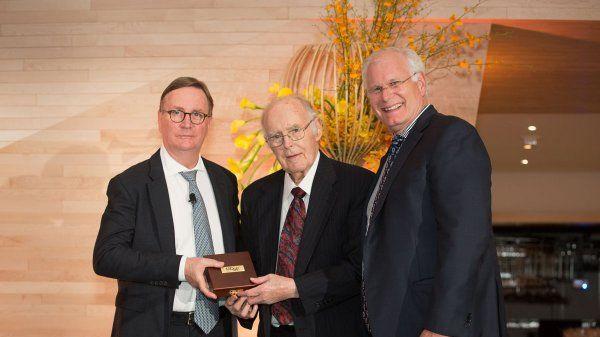

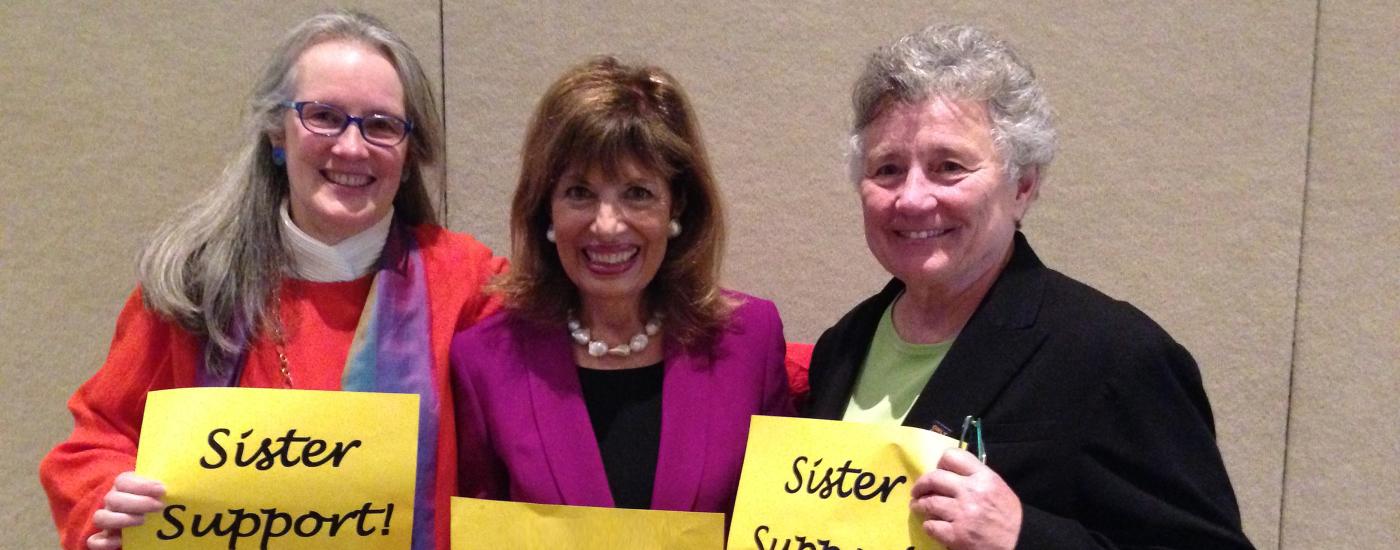
On Monday, March 28, 2011, Patricia A. Robertson, MD, Professor and Endowed Chair for Obstetric and Gynecologic Education and Director of Medical Student Education in the Department of Obstetrics, Gynecology and Reproductive Sciences at UCSF received the Chancellor's Award for the Advancement of Women in the faculty category from UCSF Chancellor Susan Desmond-Hellmann (with Dr. Robertson).
"Patty has been an innovative force for change ever since she joined UCSF," notes Nancy Milliken MD, Director of the UCSF National Center of Excellence in Women's Health and vice dean of the School of Medicine. "We celebrate Patty's many achievements and thank her for all she has done to advance women at UCSF and beyond." We invite you to read her acceptance remarks below.
Thank you Chancellor Desmond-Hellmann.
Thank you to my nominators Dr. Linda Giudice – my department chair, to my colleagues Dr. Carol Miller and Dixie Horning and to the committee who selected me for this award. I especially thank my partner Susan, my family and friends; my colleagues, including physicians, nurses, social workers, unit clerks and others; my staff Julie Lindow, Tracey Jones, and Rhose Salazar; my patients, and other community members who have shaped me and supported me in my work. I welcome all of you who have come today. In doing so, you honor all women.
I was raised in the 1950s when women had essentially three career choices: teacher, secretary or nurse. I always ended up with the black doctor bag when I played medical office with my siblings, somehow knowing I wanted to be a doctor since the age of 5. Despite my gender variant career direction for that time, my parents believed in me, for which I will always be grateful.
When I applied to medical school in 1971, I discovered that there was an unspoken agreement regarding a discriminatory policy of a 10% cap on the admission of women and a 5% cap on people with Jewish heritage. I entered the University of Texas Medical School at San Antonio as one of 12 women in a class of 125.
One of my favorite activities that sustained me during those first two years of medical school classes was working at the local free clinic. The clinic resembled a house rather than an office building, so one evening I asked: "What was the story around that?" I was informed that the house had been a gift from a physician who had died in prison from tuberculosis. He had been jailed for doing illegal abortions, trying to save lives of women who otherwise would have sought abortions from untrained lay people in the community. Among the women we saw at our free clinic were some with unplanned pregnancies who sought terminations. The women with means were able to fly to California where they were taken care of by a network of providers. There were nurses stationed at the airport to assist women who were waiting for flights back if they had excessive bleeding. Tragically, there were other women who could not afford to leave Texas for their abortions. I will never forget standing by helplessly while fourteen-year old girls died in hospital corridors of septic shock from coat-hanger abortions despite our best efforts and antibiotics. On the other hand, I still remember my tears of joy and wonderment as I watched my first delivery of a baby who was welcomed into a family with eight siblings. These experiences taught me never to judge the choices of my patients and to simply focus on providing safe and high quality health care to all who need it.

But back to my experience in medical school in the dark ages, when women were a 10 percent minority. Yes, there were many gender-related challenges and, in the interest of time, I will give you only one example. There were Playboy Bunny slides shown during hematology lectures to "keep the men engaged", so the professors explained. What about us, my female colleagues and I asked each other, What about female medical students who were so distracted by the slides and their message that we couldn't concentrate on the material we needed to learn following these slides? When it happened in a subsequent lecture, all 12 of us women walked out together and the slides were never seen again. I learned then that there is power in grassroots collective action even as a minority group if you have the peer support and the courage to take a stand.
What brought me to San Francisco was a Gyn Oncology elective with Dr. Ed Hill. I fell in love with UCSF. I was fortunate to match later that year at UCSF as an ob-gyn resident but once again was a minority as the only female resident in our cohort of 6. The lone female faculty member in our department at that time was Dr. Carolina Braga; I received great support from her then as I do today by her being here to see me accept this award. Thank you Dr. Braga! I remember her story about gender discrimination and change. There was to be an audit in the School of Medicine regarding gender salary equity. Magically, the night before the audit, Dr. Braga was called by her department chair and informed that her salary had just been doubled. Remember there is great power as well as detail in those audits which can shine the light on inequity and require accountability.
After residency, my journey took me into private practice for five years in LA, during which time on my intermittent visits to San Francisco and UCSF, Dr. Robert Jaffe, the department chair, reminded me of my mission to teach. I returned to UCSF as a faculty member in 1985. Over the next few years I was joined by Drs. Nancy Milliken, Jeanette Brown and Elena Gates. We finally had a critical mass of women on our faculty. Our support of each other helped sustain us as we launched our careers. I cannot emphasize enough the importance of a critical mass if one wishes to enhance the diversity of an organization. I am proud to see Nancy, Elena and Jeanette in their leadership positions in different areas in the School of Medicine today. It has not been an easy journey, but I would not trade it for anything. It is thrilling to look at our department now and recognize its accomplishments in advancing women's health worldwide from the efforts of men and women faculty as well as staff working together.
Where are we now?
We still have work to do!
Medical school classes are now 50% women but many issues remain. A recent study was published that medical students who are daughters of women physician suffer the same amount of sexual harassment in the workplace that their mothers did. Why aren't there more women at the rank of professor at UCSF and nationally? Why don't we have more women of color on our faculty? Why do we assume that physicians of color "should return" to their communities of origin to serve, rather than to stay in academics to contribute to medicine and also serve as vital role models for our students of color? Why do female faculty members have less lab space than male faculty, first noted at MIT? Why have we not solved the issue of mothers in the workplace so that we maximize the needed contributions of mothers? Our waitlists for childcare are still years long at UCSF despite the hard work of my co-winner (Tracey Gearlds, Director, Campus Life Services). We have a fellow in my division of maternal-fetal medicine, who signed up for UCSF childcare when her pregnancy test turned positive. Three years later, her son is still on the waiting list. How can a faculty member focus on a tight grant deadline when worried about their infant parked at a concerning family daycare home? How many times did I myself bring my own children when they were sick to my office and settle them under my desk with their backpack of books, blanket, and flashlight when I did not have adequate back-up sick childcare? There persists a deluge of judgments by family and society regarding the role of mothers. A refrain that one is likely to hear as a mother with a professional career is this: if a mother really cares about her children, she would stay home with them or only work part-time. This happens despite research to the contrary that children in daycare thrive just as well developmentally and academically as those children of stay-at-home mothers. We know through research that major determinants of the outcome of children are maternal educational level and the mother's mental health. Why can't we support women societally in whichever choice they make and not judge? I am saddened to find that some young women still feel that they have to either choose a career versus motherhood, or do a "mommy track" within a career.
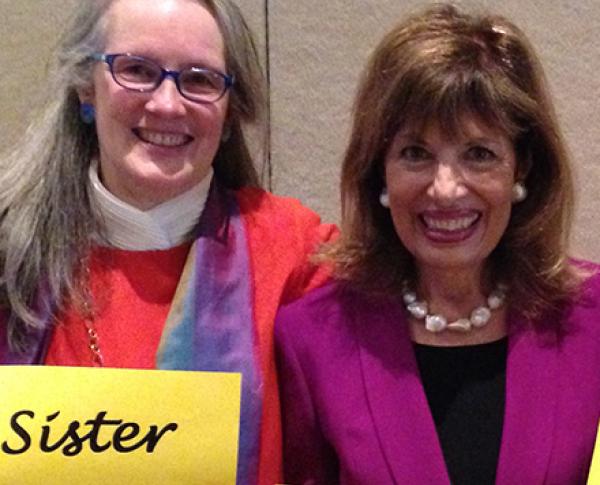
Many political challenges remain. The Equal Rights Amendment to our Constitution has never been passed. Women still only earn $.70 on the dollar for the exact same work that men do, and that does not exclude the field of medicine. And there are populations of women who are neglected from research and clinical care. When Sue Dibble (right) and I co-authored the first textbook on lesbian health this past year (Lesbian Health 101, UCSF Nursing Press), we did it all on our own time in the evenings and on the weekends, reflecting the absence of any federal support for LGBT research and the dissemination of important clinical knowledge addressing health disparities. Access to comprehensive health care is being restricted as Planned Parenthood, Lyon-Martin Health Services and other vital community clinics for women are under siege in San Francisco and nationally. Globally, women are dying at unconscionable rates in childbirth from lack of health care and empowerment.
These problems can seem daunting but not if we realize how many people want to work on them and that we can break them down into manageable pieces. I am going to share with you a couple of small pieces I have taken on in the past few years at UCSF, and how thrilling it has been to watch them develop. The first was my shock that our hospital breastfeeding statistics were among the lowest in the Bay Area five years ago. I started the Parnassus Lactation Task Force, and turned it quickly over to midwife Sharon Wiener. Through her able leadership and a lot of hard work of a diversity of health care providers and administrators, we are now number one in the Bay Area and number four in the state for exclusive breastfeeding on discharge.
Another piece I took on reflected my increasing awareness of the leaky pipeline of undergraduate women of color who lose their life dream of becoming a doctor through being immersed in the large science classes at UC Berkeley. These students do not have the time to volunteer in a lab at UC Berkeley during the school year as they are often working 15 to 20 hours a week to support themselves and frequently sending money back home to support their families at the same time. In response to this, Dr. Juan Guerra at Kaiser Oakland and I started a summer research program at UCSF for these underrepresented UC Berkeley students called the Undergraduate Research Internship. Thanks to the support of funds from Kaiser Permanente, my Endowed Chair, and generous donors such as Drs. Silvija and Roger Hoag and Lisa and John Pritzker, this program continues into its third year this summer. By receiving stipends from the summer research program and mentorship from UCSF faculty and medical students, these talented pre-med students from UC Berkeley focus on research and explore their interest in medicine. Two of them now have been accepted to medical school, another two continue their research in UCSF labs for their honors theses, and the others are in various stages of their medical school applications. This program gives me hope for the future, and confidence that our profession and our UCSF faculty will someday reflect the population we serve. You, too, can take small pieces and make a difference.
Today is also a very special day for me in that 28 years ago I became a mother with my first-born. My daughter Kate is now a rising third year medical student at UCSF. Happy Birthday Kate!
My final remarks are for my daughter Kate, my son Jonny, my co-daughter Kell, my nieces and nephews, my young friends Max, Gus, and Lola and their generation. Although you may not call yourselves feminists, you do care deeply about social justice. I encourage each of you to step up to the plate to continue our progress in women's health, education and rights, as women are key to the development of a civil and progressive society. Stay engaged, pick a cause, contribute and know that our generation is here to partner with you. At UCSF with Sue Desmond Hellmann as our new Chancellor, Renee Navarro as our new Vice-Chancellor for Diversity, and the rest of the UCSF team, we have a landscape of new possibilities, but we need you to hold us accountable with your ideas, energy and impatience. We need your help on all levels to continue to try to create a just and peaceful world that includes women's full participation.
Thank You.
News story on Dr. Robertson's award
Department of Obstetrics, Gynecology and Reproductive Sciences
Lesbian Health 101, UCSF Nursing Press
Early Interventions Result in High Rates for Breastfeeding at UCSF Benioff Children's Hospital
UCSF-Kaiser Undergraduate Research Internship
Photos by Brian Auerbach